The MSTR Trap: Why Bitcoin’s Drop Could Trigger a Liquidity and mNAV Death Spiral
1. Who is MSTR?
Strategy Inc. (MSTR), formerly MicroStrategy, has transformed from a conventional enterprise software firm into the world’s largest publicly traded corporate holder of Bitcoin. Led by Executive Chairman Michael Saylor, the company has pioneered a highly aggressive and leveraged corporate treasury strategy, effectively functioning as a leveraged Bitcoin proxy; a structure unique in public markets.

This unprecedented financial engineering, utilizing convertible debt and equity offerings to fuel continuous BTC acquisitions, has delivered exponential returns during cryptocurrency bull cycles. However, this same leverage represents a structural risk. The most critical challenge is the potential for a significant drop in Bitcoin’s price to trigger a dangerous feedback loop involving the company’s market value to net asset value (mNAV), a concept that sits at the heart of MSTR’s investment thesis and its risk profile.
The recent market volatility, combined with MSTR’s announcement of plans to raise substantial cash reserves, signals a growing corporate awareness of this risk. Investors must understand the complex mechanisms of MSTR’s leveraged structure, specifically how a decline in BTC can push the mNAV below a critical threshold of 1, potentially forcing the company to liquidate assets or face severe market contagion. This article is a deep-dive analysis of MSTR’s dual business model, its financial engineering stack, and the critical risk factors that define its suitability as a high-conviction, long-term investment.
2. Company Overview
Strategy Inc. was founded in 1989 by Michael Saylor and Sanju Bansal as a provider of business intelligence (BI) software. For decades, it was a respected, albeit mid-sized, player in the enterprise analytics space, primarily competing with giants like SAP and Oracle. This original business, though now overshadowed, continues to provide a crucial foundation of recurring revenue and operating cash flow.
The Pivot to Bitcoin (The Treasury Strategy):
In August 2020, citing concerns over inflation and the weakening dollar, the company announced Bitcoin as its primary treasury reserve asset. This decision marked a fundamental shift, transforming MSTR into the world’s first Bitcoin Development Company (as they now refer to themselves) and a de facto leveraged Bitcoin ETF.

- Mission: To use the capital markets and cash flows from operations to acquire and hold Bitcoin, which they view as the world’s most robust digital capital and an essential component of a corporate treasury strategy.
- Core Products (Dual Model):
- Bitcoin Treasury: The strategic acquisition and holding of a massive Bitcoin reserve (latest holdings are approximately 660,624 BTC with an average cost basis of roughly $74,696 as of December 2025).
- Enterprise Analytics (MicroStrategy ONE): An AI-powered business intelligence platform utilizing machine learning, HyperIntelligence, and generative AI features (branded ‘Auto’) to deliver seamless data insights to global enterprises.
- Basic Financial Footprint: While the BI segment generated approximately $128.7 million in revenue in Q3 2025, the overall financial picture is dominated by its digital asset strategy, resulting in a Q3 2025 net income of $2.8 billion due to unrealized gains on BTC.
- Total Addressable Market (TAM): The company operates across two distinct, massive markets:
- Enterprise Analytics TAM: Estimated to be a $30+ billion market by 2028, driven by AI and data modernization.
- Bitcoin Treasury TAM: Unquantifiable, but theoretically includes all sovereign wealth funds, corporations, and institutions seeking a non-sovereign store of value, making it potentially trillions of dollars.
3. Technology & Core Innovation
MSTR’s innovation is expressed in two primary, yet interconnected, technological stacks: its Enterprise Analytics platform and its sophisticated financial engineering framework for Bitcoin acquisition.
3.1. Enterprise Analytics: MicroStrategy ONE & AI
The legacy business is anything but stagnant. The company’s flagship product, MicroStrategy ONE, is an AI-powered enterprise analytics platform designed to create a Universal Intelligence Layer for its customers.
- Core Technology Stack: The platform is cloud-native, leveraging open APIs and a rich SDK for seamless integration. Its back-end is anchored by the Intelligence Server, a powerful analytics engine that processes massive datasets from diverse sources, data warehouses, cloud applications, Excel files, etc.
- Differentiators: HyperIntelligence & Auto-AI:
- HyperIntelligence: This innovative feature is a cornerstone differentiator. It allows users to overlay contextual, bite-sized AI insights directly onto any web or mobile application without integration. By simply hovering over a word (e.g., a customer name or product ID), a “HyperCard” pops up with relevant BI data, eliminating the need to leave their workflow.
- Auto (Generative AI): The platform incorporates a proprietary generative AI solution, “Auto,” which powers natural language querying within HyperIntelligence. Users can ask questions about the data, and Auto provides instant, trusted responses sourced from the governed BI layer.
- Performance and Scalability: MicroStrategy ONE is engineered for enterprise-grade security and governance, ensuring the data accessed by AI is trusted. Its architecture is built to support high user concurrency and massive data volumes, a non-negotiable requirement for Fortune Global 500 clients.
- Technical Risk Factors (Software): The core risk in the software division is market share erosion from cloud giants (e.g., Microsoft Power BI, Google Looker) that bundle BI tools with their cloud offerings. MSTR’s pivot to AI and HyperIntelligence is a necessary defense but requires continuous, costly R&D.
3.2. Financial Innovation: The Leveraged BTC Treasury
MSTR’s most critical innovation is its financial structure: the use of convertible debt and equity as a non-dilutive (or less dilutive) means to acquire BTC. This constitutes a unique form of “financial technology” that transforms MSTR’s equity into a leveraged derivative of Bitcoin.
- The Flywheel Mechanism:
- Raise Capital: MSTR issues low-interest (often 0% coupon) convertible senior notes or perpetual preferred stock, frequently with significant premiums (e.g., 35%–55% premium over current stock price).
- Acquire BTC: The net proceeds are immediately used to acquire Bitcoin, increasing the company’s treasury holdings.
- Stock Appreciation: As the Bitcoin price rises, MSTR’s market capitalization increases, often at a premium to the underlying Net Asset Value (NAV) of its BTC holdings, which is expressed as the mNAV Ratio.
- Cheap Debt: The high stock price ensures that, if the notes are converted, MSTR issues fewer shares (due to the high conversion price), minimizing dilution and lowering the effective cost of capital. This success then allows the company to issue more cheap debt or equity to repeat the process.
- Convertible Senior Notes: These instruments are the engine of leverage. They allow MSTR to borrow billions at near-zero interest rates. The key feature is that MSTR often has the option to settle the debt in either cash, stock, or a combination. The expectation of a high future stock price (driven by BTC) makes this debt attractive to investors who seek equity upside with fixed-income downside protection.
- Weaknesses/Limitations (The mNAV Risk):
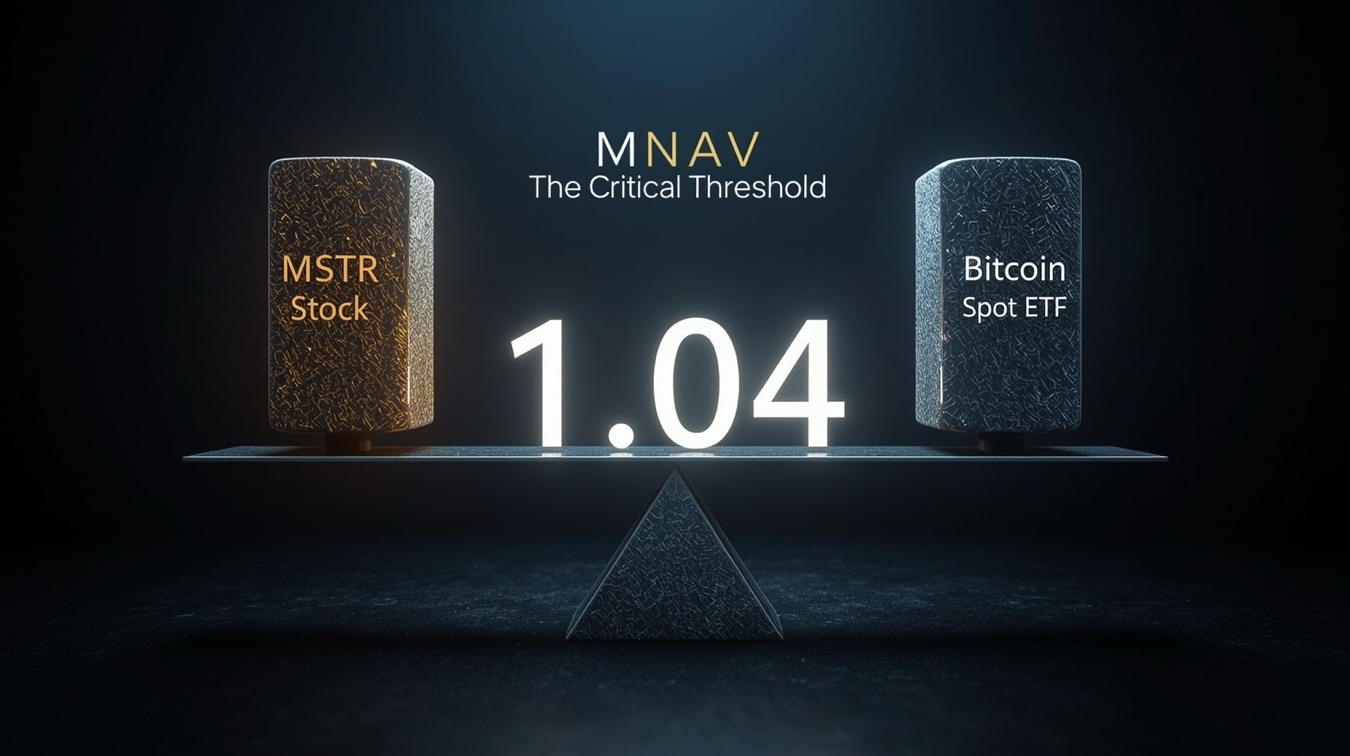
- The mNAV Critical Threshold: The Market Value to Net Asset Value (mNAV) ratio is paramount. When the ratio is above 1, investors are willing to pay a premium for MSTR stock over the underlying BTC value, validating the strategy. If BTC drops significantly, MSTR’s market cap will fall faster than the BTC price (due to de-risking and the leveraged effect), causing the mNAV to drop toward 1 or below.
- The Psychological Crack: If mNAV drops below 1, it becomes economically irrational to buy MSTR stock, as buying direct BTC becomes cheaper. This “faith crack” could trigger a severe stock sell-off, which the company and Saylor have explicitly warned against.
- The Negative Gamma Squeeze: A rapid stock decline, often associated with a BTC drop, triggers a “negative gamma” dynamic. Market makers who sold call options to hedge MSTR’s constant equity issuance are forced to sell MSTR stock as the price falls, accelerating the decline and creating a self-fulfilling downward spiral – a “death spiral” scenario.
4. Business Model & Revenue Engine
MSTR operates a dual business model: the legacy software business provides cash flow, while the Bitcoin treasury strategy acts as the primary, high-growth revenue engine.
4.1. Enterprise Analytics Revenue Streams
This legacy division focuses on recurring revenue streams, offering stability and organic cash flow.
- Subscription Services Revenue: This is the most crucial part of the software business, representing cloud-based offerings and subscription-based licenses. It showed robust growth of 65.4% year-over-year in Q3 2025, totaling $46.0 million. This indicates a successful transition to a modern, recurring cloud model.
- Product Support Revenues: Fees for maintaining, supporting, and upgrading perpetual licenses. This is a mature, high-margin, sticky revenue source, though it has seen slight year-over-year declines as customers migrate to subscription models.
- Product Licenses: One-time fees for perpetual software licenses, a declining segment in the industry.
- Professional Services: Consulting, training, and implementation services, which are low-margin but help drive adoption and retention.
- Gross Margin: The software business maintains an exceptional gross margin, hitting 70.5% in Q3 2025, highlighting its established moat and pricing power.
4.2. Capital Accumulation Engine (The Treasury)
This is the dominant growth and value driver, fueled by aggressive capital market activities.
- Revenue Streams (Indirect):
- Debt Issuance: Raising billions through 0% or low-coupon convertible notes. This is effectively cheap, non-dilutive debt used to buy an appreciating asset.
- Equity Issuance (ATM/STRE/STRF/STRD): Using At-The-Market (ATM) programs to issue stock when the price is high. This is where MSTR extracts the mNAV premium, converting it into cash to buy more BTC.
- Unrealized Digital Asset Gains: The primary driver of reported Net Income. Under accounting rules, MSTR marks its BTC to market, generating massive income/losses on paper, which dominates the overall P&L. (Q3 2025 Operating Income includes $3.9 billion unrealized gain).
- Unit Economics (Capital): MSTR’s unit economic is simple: Cost of Capital < Long-term Appreciation Rate of BTC. By achieving a cost of capital near 0% through highly-premiumized convertible debt and a high mNAV, the company has maximized the spread between its borrowing cost and Bitcoin’s historical growth rate.
- Business Moat & Defensibility: MSTR’s primary moat is first-mover advantage, scale, and Saylor’s conviction.
- Scale: Holding 660,624 BTC is nearly impossible for a competitor to replicate due to liquidity constraints and the immediate, massive market impact such purchases would cause.
- Financial Structuring: Its highly sophisticated, low-cost debt structure has no comparable in public markets.
- Saylor Premium: The market awards a premium for Michael Saylor’s singular, unwavering focus on Bitcoin, creating the mNAV > 1 phenomenon.
5. Financial Analysis & Growth Outlook
MSTR’s financials are a study in contrasts, where the stable, profitable software business is overwhelmed by the volatility of the digital asset treasury.
Latest Financial Metrics (Q3 2025)
| Metric | Value (Q3 2025) | Notes |
| Total Revenue (Software) | $128.7 million | 10.9% increase Year-over-Year (YoY). |
| Subscription Services Rev | $46.0 million | 65.4% increase YoY, key growth driver for BI. |
| Gross Margin | 70.5% | Consistent, high-margin software profitability. |
| Operating Income (Overall) | $3.9 billion | Includes $3.9B unrealized gain on digital assets. |
| Net Income | $2.8 billion | Driven almost entirely by BTC price appreciation. |
| Diluted EPS | $8.42 | |
| Cash and Cash Equivalents | $54.3 million | Low relative to the scale of assets/debt, highlighting reliance on capital markets. |
| Total BTC Holdings (Current) | ~660,624 BTC | As of early December 2025. |
| Average BTC Cost Basis | ~$74,696 per BTC | Constantly increasing as MSTR buys more. |
| Total Aggregate Indebtedness | ~$4.3 billion | Highly leveraged position via convertible notes. |
Growth Outlook & Catalysts
The growth outlook is bifurcated but ultimately tied to BTC.
5.1. Short-Term Catalysts (12 Months)
- BTC Price Action: The most powerful driver. Any movement toward the analysts’ high-end projection of $150,000 BTC by end of 2025 (as referenced by the company’s Q3 guidance) would significantly boost MSTR’s equity and mNAV.
- Capital Management: Successful deployment of the recently announced $1.44 billion USD reserve will stabilize the risk profile, assuring the market MSTR can meet potential debt repurchases or margin calls without selling BTC in a downturn.
- Software Innovation: Continued high growth in the Subscription Services segment validates the core business and provides a small but credible cash flow buffer.
5.2. Long-Term Catalysts (12–36 Months)
- Bitcoin Halvings: The reduction in new BTC supply following the halving events is historically bullish for price, which drives MSTR’s value.
- Institutional Adoption & ETF Flows: Increased allocation by sovereign wealth and pension funds into Bitcoin (via ETFs or direct purchase) legitimizes the asset and drives its value, exponentially benefiting MSTR.
- Debt Refinancing & Conversion: Successful conversion of upcoming convertible notes into equity (at a high price) without requiring cash repayment will significantly reduce the company’s leverage and risk profile.
Valuation Context
MSTR’s valuation is complex because it trades at a premium to its underlying Bitcoin Net Asset Value (NAV). The mNAV Ratio (Market Cap / BTC Value) is the key valuation metric. MSTR’s mNAV typically floats between 1.05 and 1.25. While this premium reflects the market’s appreciation for its unique leveraged structure and Saylor’s vision, it also means MSTR is more sensitive to sentiment.
The primary risk, and the user’s focus, is that the mNAV ratio falling toward 1.0 or below would eliminate the “Saylor Premium,” making the stock unattractive and triggering a valuation re-rating that could lead to severe capital flight.
6. Risk Analysis
The company’s extreme leverage and single-asset focus necessitate a deep, critical examination of its inherent risks.
6.1. Financial and Liquidity Risks
- BTC Price Crash & The mNAV Threshold: This is the existential risk. A significant drop in BTC’s price; for example, a sustained fall below MSTR’s average cost basis of ~$74,696, could rapidly erode the stock’s market capitalization. As the market cap falls, the mNAV ratio drops toward 1.0. If MSTR cannot manage the premium, the stock price decline is accelerated as the investment thesis collapses.
- Forced Liquidation (“Death Spiral”): If the mNAV crisis is severe enough, the combination of a plummeting stock price and potential margin calls on collateralized debt (if any) could lead to a liquidity crunch. The company’s low cash balance ($54.3M in Q3 2025) means it would be forced to sell its BTC treasury at a low price to meet debt obligations or redemptions. This forced sale, the “death spiral” is the single largest fear for investors. The recent $1.44 billion reserve announcement is an attempt to de-risk this exact scenario.
- Convertible Debt Maturity & Redemption: MSTR has billions in convertible notes maturing between 2028 and 2032. If the stock price is below the conversion price when the debt matures or becomes callable (or when bondholders demand repurchase), MSTR must repay the principal in cash. While many of the notes are 0% coupon, the principal repayment obligation is massive and must be managed through capital markets or, in a worst-case scenario, BTC sales.

6.2. Competitive and Technology Risks
- Competition from Bitcoin ETFs: The introduction of regulated spot Bitcoin ETFs provides a cheaper, lower-risk, and tax-efficient vehicle for investors seeking direct BTC exposure. This increases competition for capital and puts downward pressure on MSTR’s mNAV premium.
- Software Market Share: Despite the growth in subscriptions, MSTR’s core BI business is under constant threat from powerful, better-capitalized competitors who offer highly integrated AI/BI solutions, potentially marginalizing the MicroStrategy ONE platform.
6.3. Regulatory and Macro Risks
- Regulatory Pressures: Unforeseen regulatory action against Bitcoin, digital asset custody, or the practice of using convertible debt for speculative asset accumulation could severely impact MSTR’s operations and valuation.
- Macroeconomic Tightening: As observed with the Japanese central bank’s actions, global liquidity tightening and rising interest rates make high-risk, leveraged assets less attractive, increasing the cost of capital and putting pressure on the price of risk assets like BTC.
7. Investment Outlook
Strategy Inc. is not a traditional stock investment; it is a capital markets vehicle designed for maximum leveraged exposure to Bitcoin. It is an investment in Michael Saylor’s management, the future price of BTC, and the durability of its financial engineering.
Bull Case
- Catalyst: Bitcoin enters a parabolic phase (e.g., $200,000+).
- Thesis: The mNAV premium widens (e.g., to 1.30 or higher). MSTR successfully issues more convertible debt and highly-premiumized equity, accelerating the BTC flywheel. Its low-cost basis and massive scale create a self-reinforcing advantage, making it the most profitable and efficient way to own leveraged BTC in the public market. The software business continues its recurring revenue growth, providing a credible floor.
Bear Case
- Catalyst: Bitcoin suffers a prolonged, significant drawdown (e.g., below $50,000).
- Thesis: The mNAV ratio drops below 1.0, eliminating the premium and triggering mass capital flight. Investors sell MSTR to buy BTC directly or switch to ETFs. The company is forced to liquidate a portion of its treasury to meet debt repurchases or operational needs, initiating the “death spiral” that permanently damages investor trust and the leveraged flywheel.
Base Case
- Catalyst: Bitcoin continues its volatile, long-term upward trend.
- Thesis: MSTR’s stock remains highly correlated to BTC with a volatile, but sustained, mNAV premium between 1.05 and 1.20. The company successfully navigates its debt maturities by converting most of the notes into equity (due to the stock price being above the conversion threshold). The software business provides a low-but-stable cash flow. MSTR continues to incrementally issue new securities to buy more BTC, maintaining its status as the premier leveraged BTC proxy.
- 12–36 Month Key Drivers: Bitcoin price momentum, management of convertible debt conversion/repurchase, and the market’s willingness to pay the mNAV premium over direct ETF competition.
- Suitable Investor Profile: Highly Growth-Oriented, Extreme Risk-Tolerant, Long-Term Conviction Investors. This stock is suitable for those who view Bitcoin as a sovereign digital asset, are comfortable with high leverage, and accept the substantial risk of a 50%+ drawdown in a crypto winter.

Final Summary
Strategy Inc. (MSTR) has successfully recast itself as a leveraged play on Bitcoin, backed by a resilient, high-margin AI-powered enterprise analytics business. Its unique financial engineering, relying on low-cost convertible debt and a sustained market premium (mNAV > 1), has propelled its stock to extreme highs. However, the core investment thesis is fundamentally a risk-on trade: any significant or prolonged drop in the price of Bitcoin threatens to push MSTR’s mNAV below the critical 1.0 threshold. This loss of premium could trigger a dangerous feedback loop, the ‘death spiral’, by making equity offerings inefficient and potentially forcing the liquidation of its massive BTC treasury. Investors must weigh the unparalleled leverage to Bitcoin’s upside against the structural liquidity risk inherent in this highly sophisticated, concentrated, and high-conviction corporate treasury strategy.
Disclaimer: This article is for educational purposes only and does not constitute investment advice. Investors should conduct their own due diligence before making any financial decisions. We are not responsible for any investment losses incurred based on the information provided in this article.